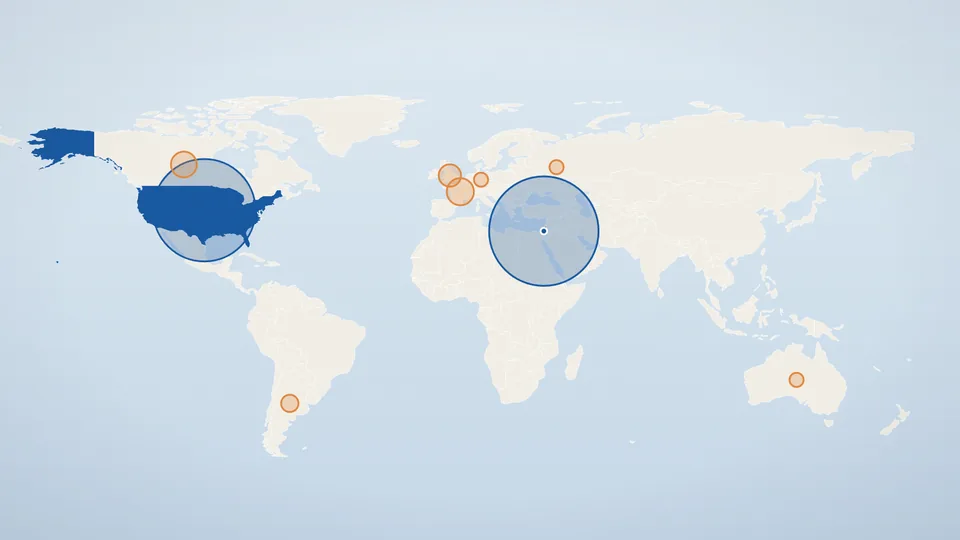
The world Jewish population was estimated at about 15.9 million as of January 1, 2026, with roughly 46% living in Israel, according to data released around Rosh Hashanah. The figure captures a major long-term demographic shift, but it is important to understand what it represents: this is a demographic estimate assembled from multiple sources, not a single worldwide census.
The Institute for Jewish Policy Research, or JPR, currently lists a more precise estimate of 15,809,000 people under its “core Jewish population” definition. That category includes people who identify as Jewish and do not have another monotheistic religion, along with some additional groups included under demographic conventions. It is not identical to a halachic definition, and it does not include everyone who may qualify for Israeli citizenship under the Law of Return.
Israel and the United States account for most of world Jewry
The latest detailed country figures do not all share the same reference date, so they should not be presented as one perfectly synchronized 2026 ranking. At the beginning of 2025, Israel’s Central Bureau of Statistics estimated about 7.2 million Jews in Israel and 6.3 million in the United States. Together, the two countries accounted for about 85% of world Jewry.
The same baseline placed France at about 440,000 Jews, Canada at about 400,000, the United Kingdom at about 300,000 and Argentina at about 180,000. Germany, Russia and Australia were each estimated at roughly 120,000. Those are beginning-of-2025 figures and should be labeled that way.
From 3% in Mandatory Palestine to about 46% in Israel
The most striking change is Israel’s growing share of the global Jewish population. In 1939, the world Jewish population was estimated at 16.6 million, with only about 3% living in Mandatory Palestine. By 1948, after the Holocaust, the global total was estimated at 11.5 million and roughly 6% lived in Israel.
The global total was about 15.7 million at the beginning of 2024, about 15.8 million at the beginning of 2025 and approximately 15.9 million at the beginning of 2026. Israel’s share is now estimated at roughly 46%. Because these figures are rounded, they are best read as a gradual trend rather than as precise annual increases.
The comparison with 1939 also shows that the global Jewish population remains below its pre-World War II estimate. That comparison is historically significant, but the data systems and definitions used across the decades are not identical.
Broader definitions produce much larger totals
JPR publishes several population “universes.” In addition to the 15,809,000 core population, it currently lists 18,766,649 people with Jewish parents, an enlarged Jewish population of 21,724,467, and a Law of Return population of 24,682,248.
Those gaps help explain why different reports can produce different totals without necessarily contradicting one another. The key question is what the number is designed to measure.
A demographic concentration with global consequences
With close to half of world Jewry living in Israel and most of the remainder heavily concentrated in the United States, the institutional balance between Israel and the Diaspora has changed substantially. Smaller communities across Europe, Latin America, Australia and elsewhere face different challenges involving aging, education, migration and the sustainability of communal institutions.
The 15.9 million figure is a useful headline. The fuller picture, however, comes from understanding where Jews live, which definition is being used and how the demographic center of Jewish life has shifted over time.